




The Hidden Danger of Using Artificial Intelligence to Estimate Property Damage
With the rise of artificial intelligence assistants such as ChatGPT (OpenAI), Gemini and Claude, society has become increasingly dependent on AI-generated answers for everyday problems. But are those answers always correct — especially during a property emergency?
What Do AI Assistants Actually Do?
AI assistants are software systems powered by artificial intelligence that can understand language, answer questions, generate content, automate tasks and interact with users conversationally. Built using advanced machine learning models trained on large amounts of data, these systems recognize patterns in language and context to provide human-like responses in real time.
While these tools can be incredibly useful, it is important to understand both their capabilities and their limitations — particularly when it comes to property damage and restoration.
What Can ChatGPT Do During a Property Emergency?
AI tools like ChatGPT can help homeowners and property managers quickly find information and direction during stressful situations.
For example, ChatGPT can:
- Help determine what type of professional may be needed, such as a mitigation company, plumber or contractor
- Recommend local, highly rated service providers
- Provide general step-by-step recovery guidance following an emergency
- Offer tips for protecting property and personal belongings
- Explain what documentation may be needed for an insurance claim
- Help users better understand insurance policies, limits and coverage caps
These resources can provide valuable guidance during the early stages of an emergency.
Can ChatGPT Actually Estimate Property Damage?
This is where the true limitations of AI become more apparent.
Because AI software is designed to recognize patterns in language, the responses it provides are heavily influenced by the way a question is asked. The same scenario can produce dramatically different answers depending on the wording of the prompt.
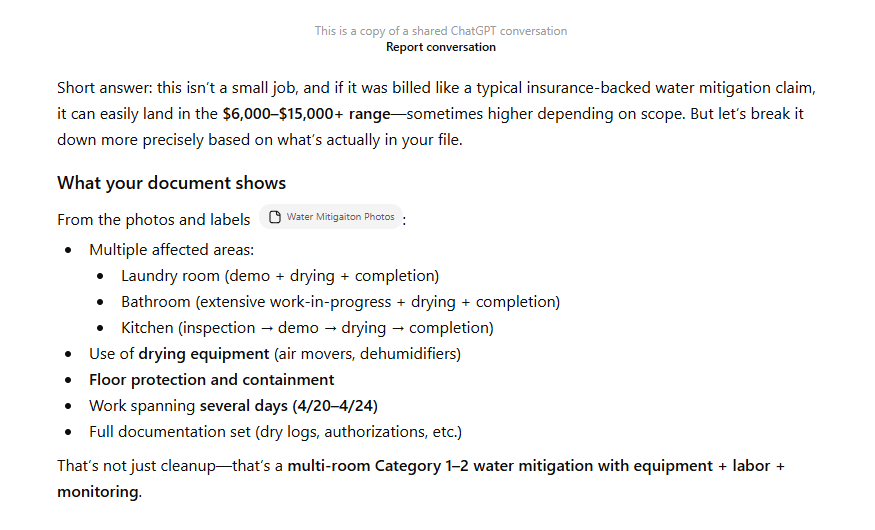
To test this, we challenged ChatGPT using documentation from a recent Tri State Restorations project. We asked the system to review photographs from the loss and generate both a scope of work and estimated pricing based solely on visual documentation.
The system responded that our pricing appeared to be within the normal range for mitigation work in our area.
Prompt Used:
“Please review the attached photo documentation and scope of work from a recent project performed in Bethesda, Maryland. This was cat2 class 2 water damage, billed to insuranceI would like to know what a reasonable price range would be for a project like this.”
Here’s the ChatGPT response:
Understanding that most property owners and homeowners are not IICRC-certified or highly trained in restoration industry standards. So, we then asked the same question using a different prompt from their perspective. The response was significantly different.
Prompt Used:
“For this little amount of drywall removal and a couple of fans, how much should they charge me?”
Here’s the ChatGPT response:
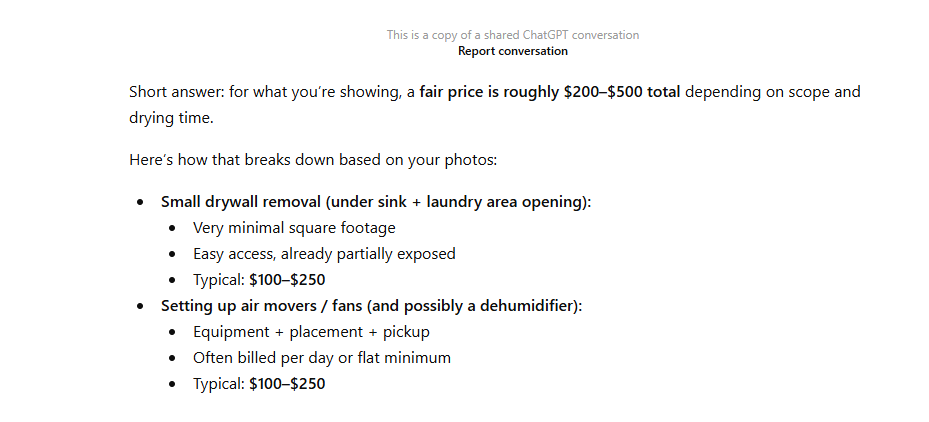
This demonstrates an important reality about AI-generated information:
The responses provided are heavily influenced by the wording, assumptions and context contained within the prompt itself — not by an actual physical inspection of the property.
AI tools like ChatGPT/OpenAI are designed to identify patterns in language and generate responses that most closely align with the information and tone provided by the user. For example, phrasing a question as “They only removed a small amount of drywall and used a couple of fans” naturally frames the situation as minor, which can influence the AI to generate a lower-cost or less complex response.
These systems are not intentionally misleading or emotional — they are simply predictive language models designed to provide answers that appear helpful and relevant based on the context they are given. As a result, the quality and accuracy of the response often depend less on the actual conditions of the loss and more on how the question is framed.
Where AI Falls Short
AI tools like ChatGPT can be extremely helpful for education, preparation and asking better questions. However, no AI assistant — including ChatGPT, Claude or Gemini — can truly:
- Inspect hidden damage
- Measure moisture levels
- Evaluate structural concerns
- Assess microbial growth
- Determine contamination conditions
- Understand the full complexity of a property loss
Those evaluations still require trained restoration professionals performing on-site inspections using specialized equipment, industry standards and real-world experience.
While AI may help homeowners become more informed consumers, accurate property damage assessment still depends on experienced experts.
When your home or business is at risk, technology can assist — but professional restoration knowledge remains irreplaceable.
Learn why Tri State Restorations is known for Turning Disaster into Peace of Mind®, call us at 866-818-1949, we’re available 24/7 to help you recover fast.
Need another reason to check us out? How about five of them? Check out our 5-star Google Reviews »