



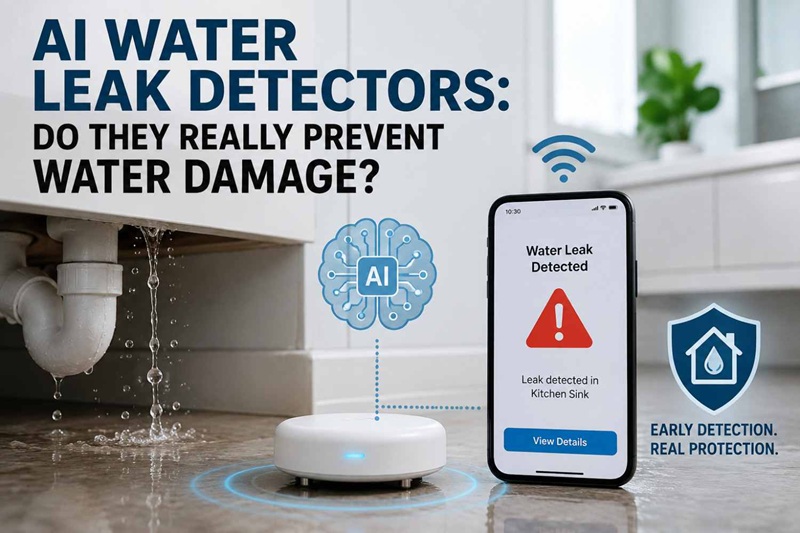
Water leaks rarely announce themselves before causing trouble. A loose connection under a sink, a failing water heater, a cracked supply line, or a slow toilet leak can continue for hours—or even days—before a homeowner notices. AI Water Leak Detectors are designed to change that by monitoring water use, recognizing unusual patterns, and sending alerts when something appears wrong. But can this technology actually prevent water damage, or does it simply tell you that a leak has already happened?
The short answer is that advanced leak-detection systems can significantly reduce the risk and severity of water damage, but they are not a substitute for plumbing maintenance. Their effectiveness depends on where they are installed, what they monitor, how quickly alerts reach the homeowner, and whether the system can automatically shut off the water supply.
Why Water Leaks Are Such a Serious Problem
Water damage can develop from a surprisingly small plumbing problem. A dripping connection may seem harmless at first, but continuous moisture can damage flooring, drywall, cabinets, insulation, and personal belongings. Hidden leaks can also create conditions favorable to mold growth.
The U.S. Environmental Protection Agency (EPA) notes that household leaks can waste thousands of gallons of water each year. Its Water-sense program recommends leak-detection and flow-monitoring technologies as tools for identifying irregular water use and reducing water waste and potential damage.
Common sources of residential water leaks include:
- Water heaters.
- Washing machines.
- Dishwashers.
- Toilets.
- Sinks and faucets.
- Refrigerator water lines.
- Supply lines.
- Aging plumbing connections.
- Frozen or burst pipes.
- Irrigation systems.
The challenge is timing. By the time a homeowner sees water on the floor, the leak may have been active for a considerable period.
How Do AI Water Leak Detectors Work?
Unlike a basic water sensor that simply reacts when its contacts become wet, modern systems can monitor water flow, pressure, moisture, temperature, and household usage patterns.
An AI-enabled system can establish a baseline for normal water consumption. For example, it may learn that a household generally uses water in the morning, evening, and around meal times. If water continues flowing at an unusual rate when nobody is expected to be using it, the system can flag the activity as potentially abnormal.
Some whole-home systems use flow and pressure data rather than waiting for water to reach a floor-mounted sensor. This can provide an earlier indication of certain plumbing problems.
EPA materials describe two major approaches: moisture detection, which identifies unintended dampness, and flow monitoring, which analyzes the amount or pattern of water moving through a home’s plumbing.
Do They Actually Prevent Water Damage?
This is where homeowners need to distinguish between detection and prevention.
A sensor that sends a smartphone notification does not physically stop water. It gives you information so that you can take action.
A more advanced whole-home system may be connected to an automatic shutoff valve. When the system determines that water usage is abnormal or a leak has occurred, it can close the main water supply automatically.
That distinction can be extremely important.
Imagine a washing-machine hose fails while you are at work. A conventional sensor might detect water and send an alert to your phone. You still have to see the notification, get home, and shut off the water.
A system with automatic shutoff capability may detect the abnormal flow and close the water supply without waiting for you.
EPA guidance confirms that some leak-detection systems can activate an associated shutoff valve, while others only provide alarms or notifications.
Therefore, AI Water Leak Detectors can help prevent extensive damage when detection is paired with rapid intervention—especially automatic shutoff.
Detection vs. Prevention: What’s the Difference?
Understanding this difference helps homeowners choose the right technology.
1. Basic Moisture Sensors
These sensors are generally placed near areas where water leaks are likely to occur.
Examples include:
- Under sinks.
- Near toilets.
- Behind washing machines.
- Beside water heaters.
- Near sump pumps.
- In basements.
When water reaches the sensor, it can sound an alarm or send a notification.
They are relatively simple and can be useful for targeted protection.
2. Smart Flow Monitors
Flow-monitoring systems are installed in or around the home’s water supply system and analyze water consumption.
Instead of waiting for water to reach a sensor, they can identify unusual flow behavior.
This makes them particularly useful for detecting certain hidden or continuous leaks.
3. Whole-Home Systems With Automatic Shutoff
These are the most comprehensive option.
A whole-home system can monitor water usage and, depending on its design, automatically shut off the water supply when a significant abnormality is detected.
This type of system has the greatest potential to reduce the amount of water released during a plumbing failure.
Where Should You Install Leak Detection Devices?
Strategic placement matters.
Even the best technology cannot protect an area it cannot monitor. Homeowners should consider locations where a leak could cause substantial damage or where plumbing failures are more likely.
High-priority areas include:
Water Heater
A failed water heater can release a large amount of water into a basement, garage, utility room, or living area.
Washing Machine
Supply hoses and connections can fail unexpectedly. Because washing machines may be left running while nobody is nearby, they are an important location for leak monitoring.
Dishwasher
A leaking dishwasher connection can damage flooring and cabinetry before the problem becomes obvious.
Under Sinks
Small plumbing leaks under kitchen and bathroom sinks can remain hidden inside cabinets.
Toilets
Toilet leaks can waste significant amounts of water without creating an obvious puddle.
Basement and Utility Areas
Basements are particularly important because leaks may go unnoticed when the area is not regularly occupied.
The EPA recommends considering leak-detection or flow-monitoring systems and checking installed systems periodically to ensure they continue operating correctly.
What AI Can Detect That a Basic Sensor Cannot
The biggest advantage of AI-based monitoring is pattern recognition.
A basic sensor essentially asks:
“Is there water here?”
An intelligent monitoring system can potentially ask:
“Is this water usage consistent with what normally happens in this house?”
That difference can help identify unusual behavior such as:
- Water flowing continuously.
- Unexpected nighttime usage.
- Unusually high consumption.
- Changes in normal pressure.
- Repeated small leaks.
- Abnormal water-use patterns.
- Possible appliance or plumbing problems.
Some smart systems use machine learning or AI-based algorithms to learn household water-use patterns. For example, Moen’s FloSense technology is marketed as using AI to analyze household water usage, while its system can also perform leak tests and provide alerts.
However, homeowners should not assume that every device marketed as “smart” or “AI-powered” has the same capabilities. Detection methods, algorithms, sensors, shutoff functions, and alert systems vary considerably.
Can AI Leak Detection Stop Every Leak?
No.
This is one of the most important limitations.
Technology can reduce risk, but it cannot guarantee that water damage will never occur.
For example, a sensor may not immediately detect:
- Water entering through a roof.
- Basement seepage.
- Flooding from outside.
- A leak occurring outside the monitored area.
- Structural moisture problems.
- Certain very slow leaks.
- Damage caused by sewer backups.
- A pipe failure that occurs in a location the system cannot effectively monitor.
A sensor also depends on electricity, batteries, network connectivity, installation quality, and proper maintenance.
For these reasons, homeowners should view smart leak detection as one layer of protection, not a complete replacement for regular inspection and plumbing maintenance.
What Happens When a Leak Is Detected?
Depending on the system, the response may involve one or more steps:
- Detection – The sensor identifies moisture or abnormal water flow.
- Analysis – The system determines whether the event appears unusual.
- Alert – The homeowner receives a notification, text, email, phone call, or audible alarm.
- Automatic shutoff – Advanced systems may close a connected water valve.
- Inspection – The homeowner or plumber investigates the source.
- Repair – The underlying plumbing problem must be corrected.
The faster this chain happens, the greater the potential reduction in water damage.
Are AI Leak Detectors Worth It for Homeowners?
For many homeowners, the answer can be yes—particularly when the property has a finished basement, expensive flooring, older plumbing, multiple bathrooms, rental occupants, or a history of plumbing problems.
The value becomes even greater when the homeowner is frequently away from the property.
A traditional moisture sensor can be useful for a relatively small investment. A whole-home flow-monitoring system with automatic shutoff generally offers broader protection but may require more installation work and a larger upfront investment.
The right choice depends on the property’s plumbing configuration and the homeowner’s risk tolerance.
Can Leak Detection Systems Lower Insurance Costs?
Potentially, but homeowners should not assume that installing a device automatically guarantees an insurance discount.
Some insurers have programs that reward qualifying smart-home protection systems. For example, USAA currently describes a Connected Home program involving eligible water leak detectors, although availability and eligibility can vary by location and policy.
Some insurance programs may also distinguish between simple detection and systems capable of automatic water shutoff.
Before purchasing a device specifically for an insurance discount, homeowners should contact their insurer and ask:
- Is a leak-detection device eligible for a discount?
- Does it need automatic shutoff capability?
- Are specific brands or certifications required?
- Does installation need to be professionally completed?
- Is the discount available in my state?
- Do I need to provide proof of installation?
Insurance coverage itself also varies. The Insurance Information Institute notes that different types of water damage can fall under different insurance policies and that sewer or drain backup coverage may require additional protection.
How to Choose an AI Leak Detection System
Before buying a system, look beyond the word “AI.”
Consider these features instead:
Whole-Home Monitoring
If your objective is comprehensive protection, look for a system capable of monitoring water use throughout the home.
Automatic Shutoff
This may be one of the most valuable features because detection alone still requires human intervention.
Smartphone Alerts
Real-time notifications can be especially useful when you are away from home.
Flow and Pressure Monitoring
These technologies can identify abnormalities that a simple moisture sensor may miss.
Point Sensors
Additional sensors near water heaters, washing machines, sinks, and other vulnerable locations can create multiple layers of protection.
Battery Backup
A system should ideally continue providing protection during certain power interruptions.
Reliable Connectivity
If the system relies on Wi-Fi or another network connection, homeowners should understand what happens if connectivity is lost.
Maintenance Alerts
A good system should make it easy to identify sensor, battery, or equipment problems.
AI Technology Is Helpful—but Maintenance Still Matters
One common mistake is assuming that smart technology eliminates the need for traditional home maintenance.
It does not.
Homeowners should still inspect plumbing connections, replace aging hoses when appropriate, monitor water bills, and address small leaks immediately.
The EPA recommends checking for leaks and periodically verifying that installed leak-detection and flow-monitoring systems are operating correctly.
Think of smart detection as an additional safety net.
Your plumbing inspection finds problems before failure.
Your leak detector watches for abnormal conditions.
Your automatic shutoff can potentially limit water release.
Together, these measures are considerably more useful than relying on any single technology.
Final Verdict: Can AI Water Leak Detectors Prevent Water Damage?
Yes—but with an important qualification.
AI-powered leak detection can help homeowners identify abnormal water use earlier and, when combined with automatic shutoff technology, can potentially stop or significantly reduce the amount of water released during certain plumbing failures.
But no system can prevent every type of water damage.
The strongest approach is a layered one:
Regular plumbing maintenance + strategically placed sensors + whole-home monitoring + automatic shutoff + fast response.
For homeowners concerned about expensive repairs, the goal should not simply be to know that a leak exists. The goal is to detect the problem early enough to limit the damage.
That is where smart water monitoring can provide its greatest value.
If a leak does occur, however, prompt professional water mitigation is still important. Standing water can continue damaging building materials and belongings even after the plumbing source has been stopped. Early action can make the difference between a manageable cleanup and a much larger restoration project.
Need Help After a Water Leak?
Even the best leak-detection system cannot prevent every plumbing emergency. If a leak causes water damage, Tri State Restorations provides 24/7 water damage mitigation and restoration services throughout Maryland, Virginia, and Washington, D.C. Their IICRC-certified technicians offer water extraction, structural drying, moisture monitoring, and restoration to help minimize secondary damage and get your property back to normal quickly.